Change is hard. You’ve probably noticed that.
We all want to become better people — stronger and healthier, more creative and more skilled, a better friend or family member.
But even if we get really inspired and start doing things better, it’s tough to actually stick to new behaviors. It’s more likely that this time next year you’ll be doing the same thing than performing a new habit with ease.
Why is that? And is there anything you can do to make change easier?
How to Be Good at Remembering People’s Names
My girlfriend is great at remembering people’s names.
Recently, she told me a story that happened when she was in high school. She went to a large high school and it was the first day of class. Many of the students had never met before that day. The teacher went around the room and asked each person to introduce themselves. At the end, the teacher asked if anyone could remember everyone’s name.
My girlfriend raised her hand and proceeded to go around the room and accurately name all 30 or so people. The rest of the room was stunned. The guy next to her looked over and said, “I couldn’t even remember your name.”
She said that moment was an affirming experience for her. After that she felt like, “I’m the type of person who is good at remembering people’s names.”
Even today, she’s great at remembering the names of anyone we come across.
Here’s what I learned from that story: In order to believe in a new identity, we have to prove it to ourselves.
Identity-Based Habits
The key to building lasting habits is focusing on creating a new identity first. Your current behaviors are simply a reflection of your current identity. What you do now is a mirror image of the type of person you believe that you are (either consciously or subconsciously).
To change your behavior for good, you need to start believing new things about yourself.
Imagine how we typically set goals. We might start by saying “I want to lose weight” or “I want to get stronger.” If you’re lucky, someone might say, “That’s great, but you should be more specific.”
So then you say, “I want to lose 20 pounds” or “I want to squat 300 pounds.”
These goals are centered around our performance or our appearance.
Performance and appearance goals are great, but they aren’t the same as habits. If you’re already doing a behavior, then these types of goals can help drive you forward. But if you’re trying to start a new behavior, then I think it would be far better to start with an identity–based goal.
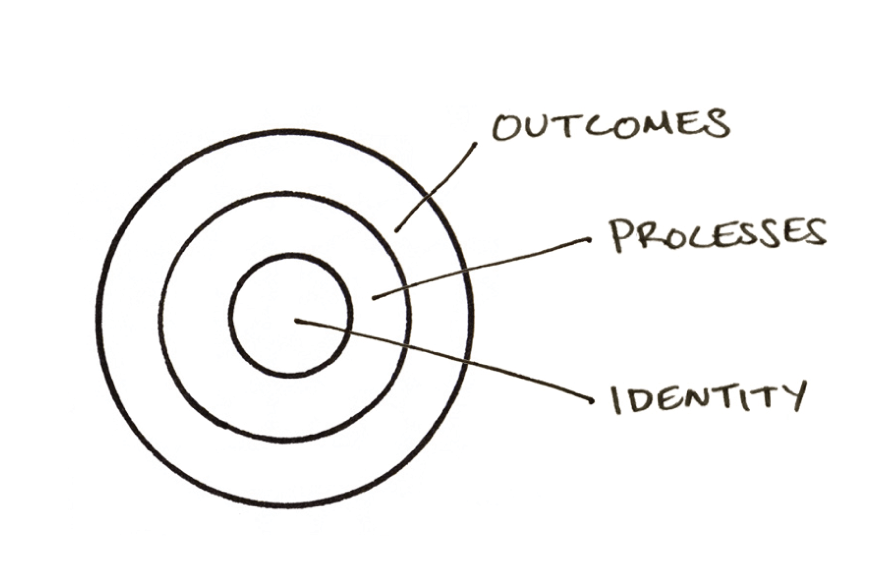
The image below shows the difference between identity–based goals and performance and appearance–based goals.

Graphic by James Clear.
The interior of behavior change and building better habits is your identity. Each action you perform is driven by the fundamental belief that it is possible. So if you change your identity (the type of person that you believe that you are), then it’s easier to change your actions.
The reason why it’s so hard to stick to new habits is that we often try to achieve a performance or appearance–based goal without changing our identity. Most of the time we try to achieve results before proving to ourselves that we have the identity of the type of person we want to become. It should be the other way around.
The Recipe for Sustained Success
Changing your beliefs isn’t nearly as hard as you might think. There are two steps.
1. Decide the type of person you want to be.
2. Prove it to yourself with small wins.
Here are five examples of how you can make this work in real life.
Note: I cannot emphasize enough how important it is to start with incredibly small steps. The goal is not to achieve results at first, the goal is to become the type of person who can achieve those things.
For example, a person who works out consistently is the type of person who can become strong. Develop the identity of someone who works out first, and then move on to performance and appearance later.
Start small and trust that the results will come as you develop a new identity.
Want to lose weight?
Identity: Become the type of person who moves more every day.
Small win: Buy a pedometer. Walk 50 steps when you get home from work. Tomorrow, walk 100 steps. The day after that, 150 steps. If you do this 5 days per week and add 50 steps each day, then by the end of the year, you’ll be walking over 10,000 steps per day.
Want to become a better writer?
Identity: Become the type of person who writes 1,000 words every day.
Small win: Write one paragraph each day this week.
Want to become strong?
Identity: Become the type of person who never misses a workout.
Small win: Do pushups every Monday, Wednesday, and Friday.
Want to be a better friend?
Identity: Become the type of person who always stays in touch.
Small win: Call one friend every Saturday. If you repeat the same people every 3 months, you’ll stay close with 12 old friends throughout the year.
Want to be taken seriously at work?
Identity: become the type of person who is always on time.
Small win: Schedule meetings with an additional 15–minute gap between them so that you can go from meeting to meeting and always show up early.
What is your identity?
In my experience, when you want to become better at something, proving your identity to yourself is far more important than getting amazing results. This is especially true at first.
If you want to get motivated and inspired, then feel free to watch a YouTube video, listen to your favorite song, and do P90X. But don’t be surprised if you burn out after a week. You can’t rely on being motivated. You have to become the type of person you want to be, and that starts with proving your new identity to yourself.
Most people (myself included) will want to become better this year. Many of us, however, will set performance and appearance–based goals in hopes that they will drive us to do things differently.
If you’re looking to make a change, then I say stop worrying about results and start worrying about your identity. Become the type of person who can achieve the things you want to achieve. Build the habit now. The results can come later.


Great post James! Inspiring and useful tips to take action right now! Thanks for pushing us!
Thanks buddy! I’m glad you enjoyed it.
Thank you again for an inspiring post which hit the spot!
You’ve hit the nail on the head for many, myself included, whom have struggled to stay constantly motivated to achieve our set goals only to regress and give into our “monkey minds”; i.e. procrastination, too-hard attitude, etc.
Finding out Who we want to become seems harder than just relying on pure willpower and motivation. We are brought up on instant gratification that we tend to shy away from actually sitting down to commit time towards a bit of soul searching/self realisation.
Have a great new year ahead James!
On a side note, you have inspired me to take up photography again and have started with a 52 week photo blog project. Celebrating small wins…my first images were of sunrise New Years Day having to wake up at 4am! (My first non-party filled New Year’s Eve)
Yohann — thanks for sharing. I’m glad you found this useful.
p.s. Good luck with the photography! Be sure to stop back and share some of your photos from time to time. And I’ll be sharing another photo essay soon, so be on the lookout for that.
That’s spot on James! I just wrote a post about how I’ve needed to get healthier due to some recently discovered heart disease. I’ve become one who IS healthier. One who doesn’t miss a workout. One who eats, and loves, bushels of vegetables. Remarkably, and almost without trying, I’ve become far stronger than I have in years and dropped 30+ pounds. Yesss.
What you’ve written brings to mind a quote: “Focus on results (solely what you aspire to) and you’ll never change, focus on change (small, incremental wins as you say) and you’ll get results.” Dang right!
Thanks James!
Good stuff, Garry. I love hearing about your slow march towards greatness. As always, thanks for reading.
What an inspiring article, and very well said! Thank you for your insight. It came at the perfect time in my life. I’m ready to become a person who does the goals I have, than focus on simply the goals themselves.
This has absolutely changed the way I will move forward in 2013!
That’s great to hear, Loren. Feel free to come back and share your thoughts anytime. I’d love to hear about your progress as the year moves on.
Thanks for reading!
I LOVE THIS.
I’m always striving to be a better more disciplined person but I feel burnt out and run down by all the things I want to achieve. This puts a new perspective on what I want to do. Great timing with the goal setting of 2013.
THANK YOU
Happy to help, Melodie.
Thanks for reading and, please, feel free to share your thoughts here anytime. I’m happy to have you as part of the community.
Good stuff James. I love the concept of starting with small steps and evolving into the type of person capable of delivering on the larger goals. I also like the image if appearance vs. performance vs. identity. Good stuff to put into practice.
Thanks Dave. I’m glad you enjoyed it.
p.s. Thanks for reading. You’re welcome to share your thoughts here anytime!
Great kickoff for the year James! Small wins as you say trains our mind that we can accomplish things.
It’s painful to see the fixed mindset of some people who believe “they just weren’t born with the talent” to lose 10 pounds etc.
But when you focus on the small steps and conquer those, you turn your fixed mindset into an evolving one where you realize you can learn new things and conquer new challenges.
Cheers!
Thanks for reading, Joe. And I agree, the idea of being “born with it” is rarely true.
I hadn’t really thought about it until now, but I set a lot of goals and, when I look back on the ones that I met and the ones that I didn’t, success always came (and quite easily) when it was focused on changing my own perception of myself.
This is *so* right. Thanks for sharing this, James.
Thanks buddy. As always, I’m happy to help.
My idea is that change is not difficult, it is difficult to be able to last? Forever?
I would agree with that for the most part. Trying something different isn’t too hard. Living differently, however, takes time and effort.
Of course.
This is great. Found this article from Steve Kamb at Nerd Fitness and I’m so glad I did. It’s funny how I teach this to my yoga students pretty much every day– that everything we want starts with the conversation between the mind and body, and it’s about building yourself from the foundation up– yet I’ve never thought about it in terms of goal setting before. Everything you’ve written makes so much sense… like you just placed that key word in the crossword puzzle that revealed the solution to a whole section. Thank you for this!
Kate — first, thanks for reading. And second, Steve is my main man, so I’m always excited to have a Nerd Fitness reader stop by and say hello.
I’m glad you enjoyed the article. Feel free to share your thoughts here anytime. In the meantime, I’ll do my best to keep sending the good stuff your way.
Years ago I read a book “Do It” or maybe “Just Do It” it was about goal setting. A huge book, like an English Literature book. It went through a 3×5 card system of listing pros and cons about yourself. Then setting goals and how to achieve them. Ultimately it was this very same concept. I applied it to my interest at the time and it actually worked. It began simple, I wanted to be an Artist, nothing happened, I already was an Artist. So, an Artist that sells paintings. Then my identity kicked in to start achieving goals. Something had to happen to get me there. It worked, then it stopped. I had to re-evaluate. An Artist that makes a lot of money. I had to do work, enter shows, make myself available and it worked. My identity had become what I wanted. But then it became work and the joy of art was gone, but that’s a different story (be careful what you wish for, kinda thing). Overall GREAT advice, ready to apply it to my latest adventures!!!
Shaun — thanks so much for sharing your experiences. It’s awesome to hear from people living in the thick of things and putting ideas into practice.
Feel free to drop a line here anytime. Thanks for reading.
I enjoyed reading your article and I think this framework is very insightful, but I’d like to know if you have any references to any research on this? Is this science or your experience?
Michael — good question. I do my best to cite research studies when possible, but this one is based on my personal experiences. To be honest, I believe strongly in science, but sometimes I find that the best ideas come from real world experiences.
“In theory, there is no difference between theory and practice, but in practice, there is.” –Jan L. A. van de Snepscheut
There is research around personal identity and how to change your habits where the activity is to identify who you want to be and how this person reacts in situations and then you live it for 2 weeks and hey presto you have changed. Unfortunately, I cannot remember in which habit/happiness book I read it in.
This sounds really interesting. Thanks for sharing, Charlotte. I’ll have to search around for that.
Great article. I like the idea of making your goal a part of your identity. Thanks for the post.
You bet, Desiree. I’m glad you enjoyed it.
And thanks for commenting. It’s great to have you as part of our community. Feel free to leave your thoughts here anytime.
Thank you, James. I have adopted this as my battle hymn as I become a person who doesn’t drink every day.
Such simple words and concepts inspire to achieve great changes!
J
That’s great, Jean! And thanks for sharing your story. It’s great to have you in our community.
If you have any questions feel free to give me a shout. I’m here to help.
Insightful post, James. I find I followed this approach in my life without knowing it, in a slightly different way. As I made small changes, I started following “rules” for myself, most of which I was unaware of — like not eating rice or pasta, like exercising 4 times a week no matter what, etc. Maybe you’d enjoy it, I posted about it here: http://www.theperpetualvacation.com/how-a-system-runs-my-life-why-it-should-run-yours-too/
You simplified my entire post into a VERY understandable and practical approach. You rock.
Good stuff, Marcella. I like the idea of rules (provided they are flexible enough to have fun, of course).
Thanks for sharing! Feel free to drop a line here anytime.
Awesome! I do not have problems when I decide to do something because I intuitively do what you talked about in the article. That doesn’t mean that I don’t have ideas of things I’d like to do that aren’t getting done. I think I’ll pick a couple of those ideas and apply this strategy!
Teri — sounds like a plan. Be sure to stop back and let us know if we can help. I’d love to hear about your progress.
Hi James,
I liked the article and it’s been helpful, just wanted to raise a few thoughts I had after reading and applying it.
If we can re-shape our identities through positive experience, then it would suggest that there is actually a deeper driver behind how we live than the identities we have unconsciously created.
I would say that that driver is experience. We have already crafted particular identities in response to the feedback we got when we attempted different activities. Some of us enjoyed the experiences of playing music or exercising or doing maths etc. Because we enjoyed those things intrinsically or got positive external feedback, we continued doing them and got better through practice.
Others didn’t enjoy those experiences, didn’t practice, didn’t develop the same level of skill as their peers and ultimately formed the belief that “I’m just not good at maths” or whatever.
The thing to really create lasting change then would be understanding what experience you’re looking for through these new identities, goals and actions. If you can form your identity, goals and actions based on the feelings you’re trying to experience, you will be better positioned to enjoy being that person intrinsically.
So, what experience am I looking for by being someone who writes 1,000 words every day?
What experience am I trying to feel by being someone who exercises regularly?
What experience am I looking for by getting that raise at work?
What experience am I looking for by being the guy who is always on time?
The thing is, I can tell myself I’m the kind of guy who does push-ups every day, but if I hate the experience of doing push-ups and/or don’t know what positive experience they’re giving me in a broader sense (health/strength/energy etc), then it’s still going to be difficult to make the identity I aspire to a reality in the long term.
On the other hand, if I can say “I am the kind of person who does push-ups because I enjoy the feeling of being physically strong and healthy” it may help to connect to the positive feeling I get from doing them and give me an intrinsic reason for being that kind of person.
That’s my take on it, sorry for the long post. Interested in your thoughts!
Luke — first, thanks for reading. It’s great to have you as part of the community here.
I think you raise some good points. Here’s my take…
In general, I agree with you that our experiences are what determine our identity in many ways. Perhaps some people are born believing that they are a certain way and there will always be a few delusional souls wandering around who think they are one way when they are actually another, but on the whole I think that most of us form our identities based on what we have done and what has happened to us in the past. So I think you’re on target with that.
That said, what you’re hinting at, and what I’m talking about in this article, is developing a new identity. The only way that I know how to do that is to prove it to yourself with small wins (as mentioned in the article).
All habits, good and bad, are usually just a result of tiny choices we make over and over again. Similarly, your new identity will be the result of many small wins that prove it to you over and over again.
Another good point that you mentioned is the idea of having a “why” for doing something. You mentioned it as, “I’m the kind of person who does pushups because I enjoy the feeling of being physically strong and healthy.” This is a good point and something that I plan on talking about more in the future: the goals you go after should be important to you. Don’t get healthy (or rich or whatever) just because someone else wants you to do it or because you heard it was a good idea. Do things because they matter to you.
Thanks for sharing, Luke! Feel free to drop a line here anytime. It’s comments like yours that help make this community a wonderful place for everyone.
Nice to see a positive take on the self-fulfilling prophesy! So it can work both ways like most things. This make perfect sense since we are our own harshest critic. Prove it to yourself and there is no one left to prove it to. Love the clarity of your thoughts.
I liked this idea too. It’s like the difference between saying “I am trying to quit smoking” and saying “I am proud to be an ex-smoker”.
Yep — You’re dead on it. I actually heard from a reader who recently quit smoking by telling himself that he was “returning to being a non-smoker” because there were times in his life when he didn’t smoke. That shift in perspective allowed him to believe in his new identity and kick the habit.
Thanks for reading!
James – Nice point about getting ‘too’ motivated and jumping into P90X if you just want to lose a few pounds.
It’s all about taking immediate action to change your behavior, but small, small steps with your first few actions! Otherwise.. pffft.. no one wants to do anything. Haha.
Craig — I’m glad you enjoyed the article. Thanks for taking the time to read.
And you highlight an important strategy: small, but immediate. If we immediately did more small actions (the types of things that prove our identity to us over and over again), imagine how far we could go!
p.s. It’s awesome to have you in our community. Feel free to share your thoughts here anytime.
What a great article. It is a concept that you were able to articulate so clearly. I’m one of those people who have been setting performance and appearance goals with no attention to changing my identity. I’ve also been quick to jump ship when the results do not come quickly enough. I think I’m finally ready to make some real, and positive, changes. Thank you for the assistance with motivation in a logical manner!
Cristina — first, I really appreciate you taking the time to read and I’m glad you found the article useful.
Good luck as you move forward. And remember, our community is always here to support you. It’s great to have people who are taking action (like yourself) as part of our movement. If you ever have questions, I’m here to help.
Great article, James, and a solid compliment to your interview over at http://www.fatburningman.com/james-clear-intermittent-fasting/.
The material here really struck a chord with me on two levels: 1) the important of step-goals, and 2) benefits of visualization and “big picture” thinking. I finished a short post on importance of same just this morning: http://paulonfitness.wordpress.com/2013/02/18/how-step-goals-and-big-picture-thinking-are-key-to-success/
I’m really enjoying your blog; keep it coming!
Thanks Paul. I’m glad you enjoyed it!
Thank you for these insights. This is a different way of thinking about obtaining goals I have and have failed to accomplish. This is a better way of motivating myself. I need to re-program my thought process now and make this work for me!
Glad you enjoyed the article, Michelle! If you have any questions about implementing identity-based habits in your life, just give me a shout. I’m happy to help.
Thanks for reading! It’s great to have you in our little community here.
Your circle looks a lot like Simon Sinek’s what-how-why graph. I like it.
Nice article, sir.
Hi – Great article. I think there’s a lot of truth in it. I wonder though, what advice you might give should one slip or have “small failures”. We might then go back to thinking “oh that’s just me, I really am [old identity]“.
Thank you
So this is basically the false promise of all magical thinking – “mind over matter.” In this case, think happy thoughts. It is deeply cynical, unsupported by peer-reviewed medical research and a salesman’s scam.
It is not a matter or personal enjoyment – it is a matter of professional this and standards of claims made under a professional tone.
To claim it is a matter of one persons feelings is to dodge serious and legitimate questions about the validity of any of the claims in the post. They are in fact, likely seriously misleading.
Your claim about “practice” is called anecdotal evidence. Would you allow this in medical treatment for a loved one? Do we want engineers and pilots not “getting caught up in all the details.”?
This sounds like simple hucksterism aka a sales pitch.
This is spot on – and what’s interesting is I figured this out for myself once, long ago, and then forgot!
Giving up smoking was one of the hardest things to do, for many years I focused on trying to change my behaviour, nothing worked.
Then, one day, it suddenly clicked, I realised the reason I smoked was because I associated smoking with BEing a tough guy. Yeah, I know, it’s embarrassing, but I realised I was trying to BE some sort of James Dean badass rebel with ciggie stuck to my lower lip.
Armed with this new self-awareness, it was quite easy to reframe who I wanted to be in a healthier way.
But I never made the logical leap to form a more general rule from this one experience.
Thanks for spelling this out so clearly. Now I will use this technique every day!
Jonathan — first, thanks for reading and sharing your story. It’s interesting to hear about your experiences. I’m sure there are many members of our little community that are benefiting from reading your comment.
And I’m glad you enjoyed the article. Keep up the good work!
I originally found this post in the weekly newsletter from Quora. I found it so good that I wanted to read more where it came from and ended here on your cool site. In the meanwhile, I have read a lot of your great posts.
And now I want to give something back, I want to thank you.
I want to thank you for the feeling your articles give me. They don’t make me just say “Yeah, I need to change,” while I go on with another article and forget everything. Your writings actually give me the feeling that a small thing changes inside of me, that I change a little bit. With every article a little bit more.
Thanks Steffen! I couldn’t be happier to hear that you’re enjoying the articles. I’ll do my best to keep the good stuff coming your way.
Thanks for being part of our little community!
Listened to your interview on the Byron Davis podcast today. I found your input on Identity-Based Habits very helpful. Thanks.
Thanks Marcel! I’m glad you enjoyed it.
And thanks for reading. It’s great to have you here!
Hahaha this seems to be a more health conscious (i.e Body Building/Appeaarance) version of the Secret.
I LOVE reading such things from time to time. And it was about time.
Thanks Mate, good article. Thank you for the excellent examples early on.
I honestly think this is the best article I’ve read on goals ever. I could never understand the gap between sticking to the new goals I’ve set, but the ones that are so engrained – the ones already at the core of my identity remain with me throughout my life. Very enlightening!
Thanks Dan. I’m glad you enjoyed it.
Eugene — that’s a great question. I actually wrote an article about what to do when you slip up. You can read it here: http://jamesclear.com/get-back-on-track
Thanks for reading and sharing your thoughts!
Hi there. Sorry you didn’t enjoy the article.
Like you, I certainly value proven science and peer-reviewed academic research. I’ve used proven research in many of my previous articles. (For example — here, here, here, and here.)
That said, I don’t believe that the only good ideas are found in research journals. For that matter, many ideas which sound great in theory are actually very difficult in practice. My goal is to strike a balance between proven research and sound ideas (i.e. the theory of living healthy) and real-world experiences and ways to take action (i.e. the practice of living healthy).
This article falls squarely into the practice category. It’s something that, based on my experience, can help us reframe the way we think about our goals and actually make progress on that for the long-term … rather than getting caught up in all the details.